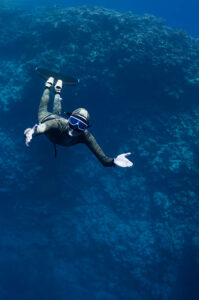
The PADI Rescue Diver Course is the course after which good divers become great ones. It challenges you to look beyond yourself, sharpen your awareness, and respond effectively when things don’t go as planned.
In this article, we’ll walk you through the 10 PADI Rescue Diver exercises, giving you a clear idea of what to expect during the course—and how these skills build confidence, control, and the ability to handle real-life dive situations.
Let’s dive into the Rescue Diver course.
Part 1: PADI eLearning
The PADI Rescue Diver Course resembles all other PADI courses in beginning with a knowledge development section which you can complete by using PADI eLearning while being in your home or hotel room, with your computer, phone or tablet.
Instead of that, the dive center you chose for the course may offer the option to complete the knowledge development part by the PADI Rescue Diver Manual.
Either way, You’ll receive a written course introduction, five reading sections with quizzes after each, then a final Rescue Diver exam. There are also tutorial videos with each of the five sections. The eLearning and the manual part also include an Accident Management Workslate.

Part 2: Self-Rescue Review
The in-water sessions of the PADI Rescue Diver course begins with a revision to the self-rescue skills that you have learned in the PADI Open Water Diver course. In particular, your scuba instructor will show you the skills, and you’ll practice them in water too deep to stand in:
- Cramp Release– Pull on the fin tip to stretch a cramped muscle.
- Establishing Buoyancy at the Surface – Inflate your BCD by low pressure and oral inflation to demonstrate positive buoyancy at the surface.
- Airway Control– Practice switching from snorkel to regulator and breathing with small amounts of
- Use of an Alternate Air Source– Find, secure, and breathe from the alternative air source of your buddy, first stationary, then while swimming together. You’ll practice as both donor and receiver, and the exercise will finish while ascending
- Overcoming Vertigo– Simulate vertigo, then use a descent line to regain direction.
Part 3: The 10 Rescue Diver Exercises
After mastering your self-rescue skills, you should move on to the next part of the 10 Rescue Exercises. Both you and your scuba Instructor will practice these exercises in confined water, then will move into the open water to demonstrate your abilities. These The 10 Rescue Diver Exercises include:
- Exercise 1 — Tired diver.
- Exercise 2 — Panicked diver.
- Exercise 3 — Assisting a responsive diver from shore, boat or dock.
- Exercise 4 — Distressed diver underwater.
- Exercise 5 — Missing diver.
- Exercise 6 — Surfacing an unresponsive diver.
- Exercise 7 — Unresponsive diver at the surface.
- Exercise 8 — Exiting an unresponsive diver.
- Exercise 9 — First aid for pressure-related injuries and oxygen administration.
- Exercise 10 — Response from shore or boat, unresponsive diver.
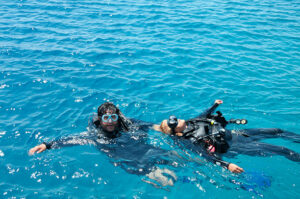
Exercise 1: Tired Diver
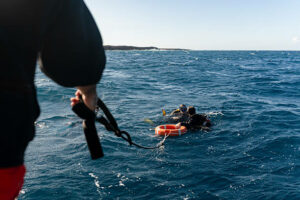
In this exercise, you will learn how to effectively deal with a tired or distressed (but still rational) diver. This skill is vital in situations in which a diver can’t reach the exit point because of fatigue or minor injury. You’ll learn a lot of towing methods and how to save energy while helping others.
During the exercise, you should concentrate on assessing the diver and the problem at first, then on acting to assist. You instructor will teach you how to:
- Approach– Approach the tired diver while keeping watching him.
- Evaluate– Assess the situation by stopping nearby, but out of the diver’s reach. Give the tired diver clear and concise instructions.
- Make Contact– Get the attention of the diver from the front while explaining your actions and establishing positive buoyancy for both yourself and the tired diver.
- Reassure– Maintain constant visual contact with the tired diver and talk to him directly.
- Transport– Tow the diver with the help of the underarm push, modified tired-swimmer carry, and tank-valve tow.
- Remove Equipment– Learn which equipment you should remove—usually the weights—and how to remove
Exercise 2: Panicked Diver
Handling a panicked diver can put the rescuer in a risky situation. When being near a panicked diver on the surface can lead to unpredictable consequences because he may push you underwater without meaning to.
With this exercise under your belt, you will master techniques that enable you to approach and calm a diver panicking on the surface, to guarantee both your safety in addition to that of the panicked diver.
Your instructor will demonstrate these skills and guide you through practicing them in Exercise 2:
- Approach– Evaluate both the situation and the panicked diver as you learned to do in Exercise 1. Attempt to communicate the diver and decide how to approach them.
- Make Contact (Surface Approach)– This is the quickest way to get to a diver who is panicking. You’ll approach from behind, grab the tank valve quickly, then move into the knee-cradle position. Instead of that, you can approach from the front, grabbing the opposite wrist of the diver in order to pull and turn the diver away from you quickly. Finally, inflate the BCD of the diver and drop his
- Make Contact (Underwater Approach)– While slower, an underwater approach is safer if the panicked diver is bigger and stronger than the rescuer. You’ll make your approach from knee- or ankle-deep underwater. The next step is to turn behind the diver and ascend, while grabbing the tank valve. Once you become at the surface, conduct the knee-cradle position and inflate the BCD of the diver, then drop his weights.
- Release – Practicing how to getaway from a panicked diver in order to protect yourself. The first choice is to descend. The second choice is to inflate both your BCD and that of the panicked diver as a try to push the panicked diver up and away.
- Quick Reverse– The final step is to prepare to back away quickly from a panicked diver using a quick reverse action. Lean backward while keeping your legs towards the diver then push off.
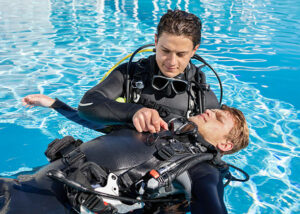
Exercise 3: Assisting a Responsive Diver From Shore, Boat or Dock
You can find yourself in an emergency situation suddenly, even after exiting the water. This scenario trains you on recognizing and responding to a problem from a distance—shore, boat, or dock—using both swimming and non-swimming assists.
You’ll learn and demonstrate the following with your instructor:
- Non-swimming Assists – You’ll practice how to retrieve a distressed diver from the shore, boat or dock with the help of a reach or extension and a throw.
- Water Entries– If the distressed diver is out of reach, enter the water while keeping your eyes on him and saving your energy. First, you’ll don the needed equipment (which is usually a mask, snorkel, fins and a floatation device), then enter the water near to the distressed diver as possible.
- Tows – You’ll practice the three tow methods from Exercise 1 again, both with and without the removal of the
- Assisting Two Responsive Divers at Once– it is rarely to encounter two responsive divers on the surface that need help. You’ll learn how to decide who to assist first.
- Exits With a Responsive Diver– Let the distressed diver rest to conserve energy before attempting to exit. If that fails, follow the steps to exit the water with an unresponsive diver (see Exercise 8).
Exercise 4: Distressed Diver Underwater
This exercise concentrates on how to identify and assist a diver who shows signs of stress or panic underwater. You’ll learn to approach them with cation and help them surface safely.
While practicing this exercise, you’ll handle cases of overexertion and running out of air. You’ll need to identify these issues quickly and respond in an appropriate way.
After finishing the exercise, you’ll need to show that you can:
- Identify and respond correctly to a diver showing signs of overexertion.
- Perform a controlled panic ascent underwater.
- Give an alternate air source to a diver simulating an out-of-air situation.
- Conduct a controlled, air-sharing ascending with another diver.
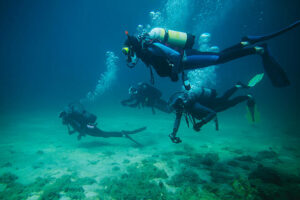
Exercise 5: Missing Diver
If a diver goes missing, this exercise trains you to use search patterns and teamwork to deal with the emergency. During this exercise, you’ll train on searching for and locating a missing diver quickly and efficiently with the help of an underwater search pattern.
You will start this exercise with your instructor by reviewing basic compass navigation in addition to an orientation to search techniques. Then, you’ll go over missing diver procedures and practice search patterns on land. In the water, you’ll apply your skills by searching for a missing diver or object.
Exercise 6: Surfacing an Unresponsive Diver
This is considered a critical exercise from the 10 Rescue Diver Exercises involves ascending with an unresponsive diver to the surface.
You’ll learn how to protect their airway and make sure they are safe while performing controlled ascending in addition to what to do once you become on the surface. You will perform this exercise in water too deep in which to stand.
Before and during this exercise, your instructor will show:
- How to use controlled positive buoyancy to help you in ascending.
- How to Ascend with an unresponsive diver to the surface by manipulating the air in both your BCD and theirs.
Exercise 7: Unresponsive Diver at the Surface
This exercise is considered the most anticipated one in the 10 Rescue Diver Exercises, Rescue Exercises. It is a challenging one but essential. During this exercise, you will learn what to do upon surfacing with an unresponsive diver. Immediate action is, without doubt, needed.
So, you’ll learn the proper way of providing rescue breaths in water (which include both mouth-to-mouth techniques as well as using of a pocket mask), how to remove both your equipment and that of the other diver, and the best way to simultaneously tow the unresponsive diver to an exit.
Here’s what the exercise will look like. Keep in mind that you will perform the exercise in water too deep in which to stand. Your instructor will guide you through the steps, then ask from you to demonstrate them:
- Once you’ve surfaced with the unresponsive diver, turn the diver face up (You can grab their opposite hands and roll them over by pulling) and establish positive buoyancy for both of you by removing both sets of weights and inflating your BCDs.
- Next, you’ll need to call for help by shouting, “Help! I have a diver emergency! Call 911!”
- Then, keep holding the head and neck of the diver, and remove his mask and regulator, then, remove your mask, and open their airway in order to check for breathing.
- If you haven’t detect breathing, give two rescue breaths (during the exercise, you’ll practice both mouth-to-rescue breathing mask as well as mouth-to-mouth rescue breaths), then you will follow them by one rescue breath every five seconds while towing the diver to the exit point.
- At the same time, You’ll practice removing both the unresponsive diver’s gear and your own between rescue breaths to prepare for exiting the victim from the water.
Exercise 8: Exiting an Unresponsive Diver
You have to exit an unresponsive diver from the water to give them the assistance they need. This one of the Rescue Diver Exercises in which you will learn various techniques for exiting an unresponsive diver, whether from the shore or a boat, while maintaining both your safety.
You’ll probably practice exits from both the boat and the shore under the supervision of your instructor. Smaller divers may worry about ascending with an unresponsive diver, but your instructor will teach the best technique based on your size and that of the injured diver.
Some of the techniques you may train on include:
- Ladder Exit.
- Saddleback Carry.
- Packstrap Carry.
- Lifeguard Exit.
- Fireman’s Carry.
- Roll-Up Technique.
Exercise 9: First Aid for Pressure-Related Injuries and Oxygen Administration
The injuries related to scuba diving, such as decompression illness (DCI), are serious. You’ll learn first aid for these injuries and how to properly give oxygen, which is essential in DCI situations.
During this exercise, you’ll learn and show you can:
- Give oxygen to a breathing unresponsive diver in a DCI situation.
- Give rescue breaths using a mask or mouth-to-mouth while giving oxygen to an unresponsive, non-breathing diver.
Exercise 10: Response from Shore or Boat, Unresponsive Diver
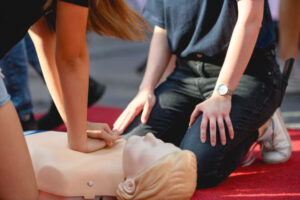
The last exercise in the Rescue Diver Exercises list combines together many of the skills you’ve practiced. You’ll handle an emergency with an unresponsive, non-breathing diver, showing in-water rescue breathing, a water exit, and providing CPR or first aid.
This is considered a comprehensive exercise that help you enhance your ability to quickly assess, act, and manage dive emergencies with efficacy.
Part 4: Open Water Rescue Scenarios
Some people might keep in mind that the two Open Water Rescue Scenarios are the in-water final exam of the Rescue Diver course. During these scenarios, you’ll combine all the knowledge you acquired in the 10 Rescue Diver Exercises to rescue both an unresponsive diver underwater and on the surface.
We won’t give everything away, but in these scenarios, you’ll gather information, assess the situation, plan with your dive buddies, and carry out the rescue. Be prepared for a challenge, and enjoy the sense of achievement when you successfully rescue the victim.
Always remember that the Rescue Diver course is more than just a certification; it’s a commitment to grow as a more skilled, confident, and responsible diver. The gained knowledge and experiences are invaluable, for your own safety and the well-being of the members of dive group.
Start the PADI Rescue Diver Course Now with DRAR DIVING Center

Take your diving skills to the next level with the PADI Rescue Diver Course at DRAR Diving Center. Our expert instructors bring years of experience and deep knowledge of local waters to every session, guiding you step by step through real-life rescue scenarios.
With their hands-on coaching, you’ll gain the skills, confidence, and awareness needed to handle emergencies and assist fellow divers safely. Learn from the best and become a more capable, prepared diver—enroll with DRAR today and dive with confidence.