The Red Sea is famous for its crystal-clear waters, colorful coral reefs, and incredible marine life, making it one of the top destinations for diving and snorkeling around the world.
While exploring this underwater paradise is generally safe, understanding how to interact with marine life and avoid common hazards can make your experience even more enjoyable.
In this guide, we’ll cover essential safety tips, proper behavior while diving and snorkeling in the Red Sea, and what to know about bites, cuts, stings, and shark encounters, so you can explore the Red Sea with confidence.
How to Be Safe While Diving and Snorkeling in the Red Sea
If you are going to practice snorkeling and scuba diving in the Red Sea in Egypt, you should know what live here in the coral reefs, what lives in the sea, what dangerous animals can be here and how to behave in the water.
Be respectful and informed, and the risk of being harmed by marine life is extremely low. The marine animals are usually shy. You are far more likely to get sunburned while snorkeling.
Best Time to Go Scuba Diving and Snorkeling in the Red Sea
You can enjoy visiting the Red Sea in all seasons, but the period between April to October is considered the ideal conditions when the water is warm with excellent visibility. The water temperature in summer range from 26°C to 28°C (79°F to 82°F), which offer comfortable conditions for both snorkelers and scuba divers for extended underwater time.
How to Behave in the Red Sea:
A few simple habits can help you stay safe and protect while diving and snorkeling in the Red Sea, including:
-
Swim alongside the reef rather than above it, because reefs usually extend close to the surface.
-
Don’t practice scuba diving and snorkeling in the Red Sea alone.
-
Avoid touching anything, or stepping on the coral reef.
-
Never feed the fish, as this disturb the biological balance.
-
Do not collect seashells, as they are often home to marine animals.
-
Avoid throwing garbage into the sea.
-
Do not collect marine animals or damage corals.
-
When an aggressive fish come towards you, leave its territory.
-
Avoid disturbing or touching the marine creatures.
-
If you’re taking photos or videos, don’t chase fish and be mindful of where you’re swimming.
-
Do not enter the water in the evening.
-
Wear Water shoes when entering the water from shore.
-
Wear a light wetsuit or a lycra t-shirt when you go snorkeling.
-
Check local conditions in advance.
When we compare the dangers we face in Egypt in the sea vs. in Europe, for instance, in the forest. When going to the forest, you are supposed to know what are waiting for you.
You may brush against nettles, get stung by a wasp, bitten by a tick, or even spot a viper resting on a rock. You know the environment of the forest, understand the risks, and know how to prevent and deal with problems if they occur. Unfortunately, some animals in nature can sting, bite, or have poisonous spines.

Bites and Cuts
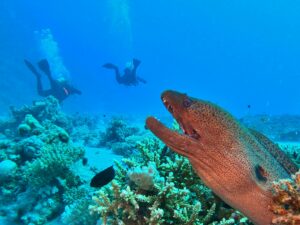
But, Why some fish behave in an aggressive way? There is a simple answer to this question which is defending its territory, for instance clownfish protecting its anemone or a surgeonfish defending a feeding area on the reef.
Some fish, such as triggerfish, protect their eggs by guarding nests dug into the sand and chasing away anything that comes too close. Most of these fish warn intruders before they attack, often by swimming quickly past. Moving away in a horizontal direction usually minimizes the risk of injury.
Usual first aid: use a disinfectant, cover the wound, and visit a doctor if necessary.
Sting with a Poison Barb
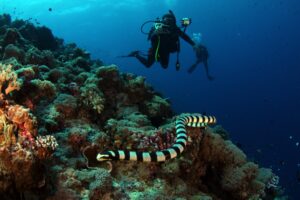
Marine creatures having poisonous spines also live in the Red Sea, including lionfish, stonefish, scorpionfish, and stingrays in addition to sea urchins. They use the spines in defending.
In most cases, the fish won’t attack you by itself. Wearing water shoes is recommended when going into the water from the beach to protect your legs if you step on a sharp stone.
If you are swimming around a coral reef, keep yourself in a safe distance and avoid reaching or climbing on the reef. This is mainly to preserve coral reefs and avoid damaging them.
Usual first aid: put the infected area in warmest possible water, take painkillers, and see a doctor if needed.
Incitement (burnt)
The fire coral is one of the stinging animals that can be found in the Red Sea, which can cause an unpleasant, long-healing red rash. So, don’t touch anything and keep yourself in a reasonable distance.
Remember that corals grow much more slowly than plants like nettles. As for other stinging animals, such as jellyfish, the species that found here in the Red Sea are generally not very dangerous. Occasionally, tiny stinging plankton may rub against you, but fortunately, the sensation is usually no worse than an ant bite.
The usual first aid: put lemon or vinegar in the rash and visit the doctor if necessary.
Sharks

There is often discussion about the dangers of sharks in the Red Sea. Although while scuba diving around Hurghada, we do not meet very often due to coral reefs, in the Red Sea there are dangerous species in the Red Sea, such as tiger shark, longfin shark, or mako.
These shark species are most commonly found near reefs that drop into deep water and have stronger currents. In Hurghada, shallow waters extend near the shore, on the other hands, deeper reef walls are located a few kilometers away beyond Giftun Island and farther in the open sea.
In the Egyptian part of the Red Sea, no shark killing cases for scuba divers. It is the same for swimmers or snorkelers, the matter is that some species that hunt close to the surface for their food can be mistaken for sharks, especially if the swimmer moves quickly, with jerky movements. Sharks usually attack moving from down to up.
If you see a shark, following it and slowly moving away is the best choice. It is a small probability that a shark attacks you. The recent incident in Hurghada has not affected diving or snorkeling activities at the reefs.
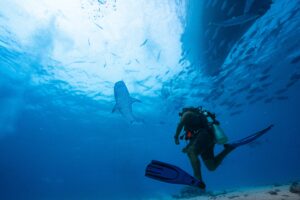
What to do as a diver when meeting a shark: stay close to the reef with other divers, keep diving in a vertical position to look bigger.
Waves and Currents
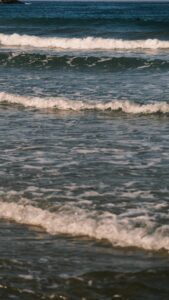
People often underestimate sea currents and the impacts of the waves that can cause uncomfortable conditions on the surface. It’s best to check local conditions in advance, for example with a nearby local diving center.
If you swim from a sheltered bay into open water, you may not be able to exit the sea over the coral reef at any time. You need to plan your return point and how far you can safely swim.
Treat the coral reefs and their inhabitants of the Red Sea with your respect. Actually, you have a greater chance to harm the reef than the other way around. Collect information and follow the rules. And then “Those who are afraid should not enter the forest”.