Do you love scuba diving so much that you want to turn this passion into a career?you can’t be blamed! life is often better below the waves. Having a full-time scuba diving job is possible. For many people, it is surprising to know the diversity of scuba diving jobs available in this industry.
There are several scuba diving jobs in which you work in fantastic conditions like diving in warm water and spotting beautiful tropical fish. Meanwhile, other jobs have harsh working conditions, such as diving in the murky cold water but these jobs can be more lucrative. Each scuba diving job will have pros and cons. To help you get started, we have listed to you about 10 of the top scuba diving jobs.
10 Scuba Diving Jobs You Should Consider
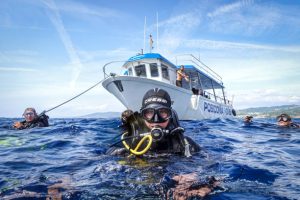
For those who have a great passion for the ocean, turning scuba diving into a career is a dream that comes true. No matter the role you play, each scuba diving job offers the opportunity to make a splash and contribute to our understanding and appreciation of the deep blue. Ready to explore these capitative careers?
- Dive instructor.
- Dive master.
- Dive shop owner.
- Underwater photographer.
- Marine biologist.
- Marine archaeologist.
- Scuba diving blogger or vlogger.
- Scuba travel agent.
- Public safety diver.
- Commercial diver.
1)- Dive Instructor
A Dive instructor is on the top of our list for scuba diving jobs. They’re often seen as the representatives of a dive shop and the faces that clients, particularly students, remember. Without them, the emergence of new scuba divers would cease..
Dive Instructor Responsibilities
The primary role of a scuba instructor include:
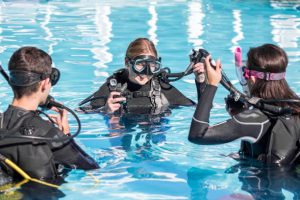
- Teaching people how to dive by providing them with both the theoretical and practical training needed to understand scuba diving concepts and techniques.
- In addition to teaching certified divers new skills, they also guide them on dives and ensure they adhere to dive plans and safety procedures.
Dive Instructor Requirements
To become a dive instructor, enroll in a dive instructor course with a recognized scuba training agency such as PADI, SSI, NAUI, etc.
Specific requirements may vary by agency, but generally:
- Have at least 100 logged dives before starting the course.
- Be a certified Dive Master.
The instructor course comprises two main parts:
- Theoretical part: Gain in-depth knowledge of scuba diving and physics.
- Practical part: Demonstrate teaching skills to an examiner.
Where a Dive Instructor Can Work
- Dive shops.
- Resorts and hotels.
- Liveaboard boats.
- Cruise ships.
- Marine research institutes.
The Salary of a Dive Instructor
Recreational scuba diving instructors earn an average of $9,006 per year, while tech diving instructors make around $29,914 annually. These figures reflect a combination of part-time and full-time work among dive instructors.
2)- Divemaster
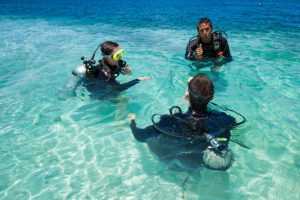
A Divemaster is a certified professional scuba diver who assists diving instructors, leads certified divers on underwater excursions, and oversees diving activities.
Divemaster Responsibilities
As a certified Divemaster, you can:
- Guide certified divers on dives.
- Assist an (Assistant) Instructor with courses.
- Work in the dive shop, including filling tanks.
- Teach certain courses that do not involve open water dives.
Divemaster Requirements
To work as a Divemaster, you must complete the Dive Master course, which is typically a hands-on program often done as an internship at a dive shop, lasting 2 to 4 months. During this part-time or full-time course, you will learn:
- how to conduct effective dive briefings
- Assisting in dive courses.
- Support discover scuba diving dives.
- Maintaining scuba diving equipment.
- How to fill scuba tanks.
- Creating dive site maps properly.
- Understanding dive physics thoroughly, and much more.
Where a Divemaster Can Work
Divemasters have numerous opportunities, including guiding certified divers, assisting in the dive shop, and filling tanks. Additionally, liveaboard boats are popular workplaces for Divemasters, as they typically have certified divers on board.
The Salary of a Divemaster
The salary of a Divemaster varies widely based on location, employer, experience, and whether they work full-time or part-time. Typically, Dive Masters can expect:
- Hourly Rate: $10 to $25 per hour, depending on the region and dive operation.
- Annual Salary: $25,000 to $60,000 per year for full-time work. Experienced Dive Masters in popular tourist destinations can earn more, especially with tips from clients.
Many Dive Masters also rely on tips, which can significantly boost their earnings. Some work on a freelance basis, leading to variable income.
Divemaster Vs Scuba Instructor
Both divemasters and scuba instructors are demanding scuba diving jobs, but If you’re undecided between becoming a Divemaster or an instructor, it’s worth noting that instructors typically earn more and are in higher demand. Dive shops generally prefer instructors over Dive Masters because they can teach courses.
3)- Dive Shop Owner
Although it isn’t considered mainly from scuba diving jobs, owning a dive shop isn’t for everyone, it is a potential role in the tourism dive industry. Successful dive shops often owe their success to factors like their location, whether inside a resort or on the main street of a popular dive spot. As a dive shop owner, you can provide a variety of dives and hire service-oriented staff.
Dive Shop Owner Responsibilities
If you want to be a successful dive shop owner, consider the following:
- Analyze your local market, including competing activities for customers’ leisure time (e.g., mountain biking, skiing).
- Determine who will handle tasks such as teaching classes, repairing gear, managing retail, and operating the boat. Avoid one person doing all tasks.
- Investigate necessary permits, zoning laws, and utility requirements.
- Decide if you will have an on-site pool or identify other options for confined water training.
- Plan your funding strategy: self-funding, crowd-funding, partner investors, or a small business loan.
- Choose your business structure.
Dive Shop Owner Requirements
There are no strict requirements for starting a dive shop; you don’t even need to be a diver. However, having a solid understanding of the dive industry and the local area is crucial. Additionally, possessing an entrepreneurial spirit is very important.
How Much Dive Shop Owner Makes
The income of dive shop owners varies based on factors such as size, location, services, and management efficiency.
According to BDI (Business of Diving Institute), the earnings of a U.S. dive center reached $541,200 in 2023, although this figure mainly represents the largest and most successful shops.
Smaller dive shops can expect lower annual revenues, typically ranging from $50,000 to $150,000. Medium-sized outlets might earn more, while the largest shops, situated in prime coastal locations, can earn between $300,000 and $800,000 or more annually.

4)- Underwater Photographer
Anyone can snap a picture, but capturing a great photo is an entirely different challenge. To become an underwater photographer or videographer, one must possess a unique set of skills both beneath the waves and during the editing process on the surface.
Underwater Photographers Responsibilities
- Plan and design the composition of photos.
- Utilize diverse photographic methods and lighting tools.
- Photograph subjects with professional quality.
- Improve the subject’s look using natural or artificial light.
Underwater Photographer Requirements
To pursue a career in underwater photography, you must be a certified diver. No other specific requirements exist, but hiring decisions are made based on the quality of your portfolio. You will also need extensive training and good photo equipment. Taking (underwater) photography course can accelerate your training.
Where an Underwater Photographer Can Work
- Dive shops
- Resorts
- Liveaboards
The Salary of an Underwater Photographer
The average salary of an underwater photographer is around $42,345 per year and $814 per week.
5)- Marine Biologist
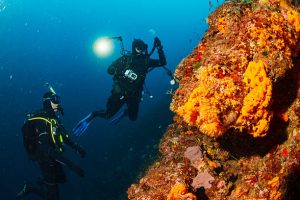
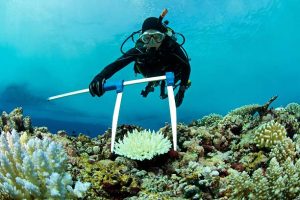
If you’re fascinated by underwater life and look for one of the unusual scuba diving jobs,, a career in marine biology could be a great choice. Marine biologists study aquatic organisms, often conducting their research while scuba diving.
There’s still much to learn about the ocean and its inhabitants, and marine biologists play a crucial role in expanding our knowledge of the marine world..
Marine Biologist Responsibilities
Their jobs can include
- Monitoring and rescuing marine animals
- Compile lots of data and undertake experiments.
- Play an essential role in the protection of rare species.
Marine Biologist Requirements
To become a marine biologist, you need to pursue a university degree in marine science or marine biology. Additionally, if your goal is to work in the ocean, obtaining a scuba diving certification is essential.
The Salary of a Marine Biologist
The U.S. Bureau of Labor Statistics (BLS) reports that zoologists and wildlife biologists earn an average annual salary of $66,350. This figure can vary based on factors such as geographic location, years of experience, area of expertise, work environment, and educational background.
6)- Marine Archaeologist
Although also academic, marine archaeologists have different focuses compared to marine biologists. Biologists study living organisms, while marine archaeologists investigate historical sites. Underwater, this often involves exploring shipwrecks or other locations that may contain fascinating artifacts.
Marine Archaeologist Responsibilities
As a marine archaeologist, you earn a living by searching for ancient treasures left by humans long ago. Before scuba diving into an area, especially on exploratory dives, archaeologists conduct extensive research on land, examining the history of the site and analyzing data sets.
Marine Archaeologist Requirements
Since you’ll be diving on wrecks, obtaining a wreck diving certification is essential. Considering that wrecks and artifacts are often found deep on the ocean floor, pursuing technical diving certifications is also advisable. Additionally, studying maritime archaeology is a typical academic path for marine archaeologists.
The Salary of a Marine Archaeologist
On average, the salary of a marine archaeologist is nearly $60,710 per year and around $29 per week.
7)- Scuba Diving Blogger or Vlogger
If you love traveling, exploring, in addition to diving, a scuba dive blogger might be one of the perfect scuba diving jobs that you can choose This job allows you to get paid to travel the world, capture amazing experiences, and share them with others. However, it’s a highly competitive field, and in the past decade, many have attempted to make a living from it, with only a few achieving success.
Scuba Diving Blogger Responsibilities
The main job of a video blogger is to produce captivating and engaging video content. As a scuba diving blogger or vlogger Companies may hire you to promote them, either on your own channels or the client’s platforms.
Scuba Diving Blogger Requirements
To become a scuba diving blogger or vlogger, you should have:
- A Scuba diving certification.
- Good writing, storytelling, and marketing skills.
- A good ability to capture good videos or shoot beautiful photos.
- Good social media skills.
Where a Scuba Diving Blogger or Vlogger Can Work
- Dive resorts.
- A Travel agency,
- Dive magazine.
- A tourism board of a specific country.
8)- Scuba Travel Agent
Who is the go-to expert for the finest diving spots worldwide? That’s right, a scuba travel agent! And how do they gain that expertise? Ideally, through their own travel adventures.
It’s well-known that personal experiences are the most effective sales tool. For this reason, agencies often send their staff on study trips. These trips can be organized by the tourism board of a country or by the employer.
Scuba Travel Agent Responsibilities
- A complete knowledge of the best scuba diving destinations around the world.
- Gain a deeper understanding of the needs of your clients.
Scuba Travel Agent Requirements
To dive and explore the destinations offered by your company, obtaining an Open Water or Advanced Open Water diving certification is essential.
9)- Public Safety Diver
A public safety diver is one of the scuba diving jobs that operated within law enforcement, often summoned to manage accidents and crime scenes. For instance, if a person is missing and suspected to be in a body of water, the safety diver is brought in to conduct the search.
Public Safety Diver Responsibilities
In addition to their primary role of recovering and rescuing individuals, safety divers also search for evidence at crime scenes. For example, they might locate a weapon that was discarded in a body of water.
Public Safety Diver Requirements
This job isn’t suited for everyone. It’s both physically and mentally demanding, requiring significant emotional resilience. However, the immense reward of rescuing someone makes it worthwhile. If you’re a good fit for the role, you’ll undergo extensive training within your law enforcement division, learning many specialized skills on the job.
The Salary of a Public Safety Diver
The average hourly wage for a Public Safety Diver in the US is $24.70, with pay ranging from $13.22 to $35.82.
10)- Commercial Diver
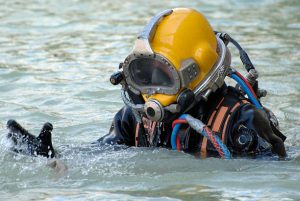
Commercial diving is a form of professional diving. It is a type of scuba diving jobs where divers perform underwater tasks for industrial, construction, engineering, maintenance, or other commercial purposes. These tasks are often akin to similar work done on land, with diving being a secondary aspect to the primary job.
Commercial Diver Responsibilities
There are several types of commercial diving, each type has its own responsibilities.
Commercial Diver Requirements
Specialized schools offer commercial diving courses, with basic training typically lasting at least 16 weeks. Additional education varies based on the specific job the commercial diver undertakes. It’s undeniably one of the most demanding scuba diving careers available.
Where a Commercial Diver Can Work
In addition to careers in tourism and law enforcement, there are opportunities in the industrial sector for commercial divers.
The Salary of a Commercial Diver
In the USA, Commercial divers typically earn an annual salary of $57,273 on average, with wages ranging from $36,839 to $89,039.